Here's a fascinating video talk by the owner/curator, Jay Walker:
Showing posts with label library. Show all posts
Dec 22, 2008
Library of the Human Imagination
Here's a personal library that most of us can only dream of. In fact, most public libraries can also just aspire to.

Stuffed with landmark tomes and eye-grabbing historical objects—on the walls, on tables, standing on the floor—the room occupies about 3,600 square feet on three mazelike levels. Is that a Sputnik? (Yes.) Hey, those books appear to be bound in rubies. (They are.) That edition of Chaucer ... is it a Kelmscott? (Natch.) Gee, that chandelier looks like the one in the James Bond flick Die Another Day. (Because it is.) No matter where you turn in this ziggurat, another treasure beckons you
- Wired News Article (includes more photos)
Here's a fascinating video talk by the owner/curator, Jay Walker:
Apr 16, 2008
200,000 books, one Geek with his computers
A very interesting New York Times article covers what is effectively a stupendous mockery of the process of creating a book. But books are produced nevertheless, and some people buy them.
The infinite monkey theorem states that a monkey hitting keys at random on a typewriter keyboard for an infinite amount of time will almost surely type a particular chosen text, such as the complete works of William Shakespeare.
- Infinite monkey theorem, WikipediaHumans cannot deal with infinity, but we can use better assistants than monkeys to reduce the time it takes. In the Information age, Philip M. Parker, has put his name to 200,000 books setting records for being a prolific author. The catch to this inhuman behaviour is an array of assistant computers programmed to fetch information online on any particular topic and compile them into a book. He explains the process in the following video.
It's unnerving to think that this process can be extended to other media like games, audio and video as well. Effectively it establishes the precedent that a person is not required to compile content into human consumption media items like books or movies.
At the library end, I wonder what this implies for cataloguers. It doesn't make sense for humans to be organizing output that comes from machines. Do cataloguers they have to be human too, or can they just be machines instantly summarizing and deriving overviews from the content?
I found some of these books here on Amazon.
The New York Times article can be found here.
It's unnerving to think that this process can be extended to other media like games, audio and video as well. Effectively it establishes the precedent that a person is not required to compile content into human consumption media items like books or movies.
At the library end, I wonder what this implies for cataloguers. It doesn't make sense for humans to be organizing output that comes from machines. Do cataloguers they have to be human too, or can they just be machines instantly summarizing and deriving overviews from the content?
I found some of these books here on Amazon.
The New York Times article can be found here.
Labels:
2008,
book,
games,
knowledge,
library,
mashup,
media,
scientists,
technology,
writing
Jul 31, 2007
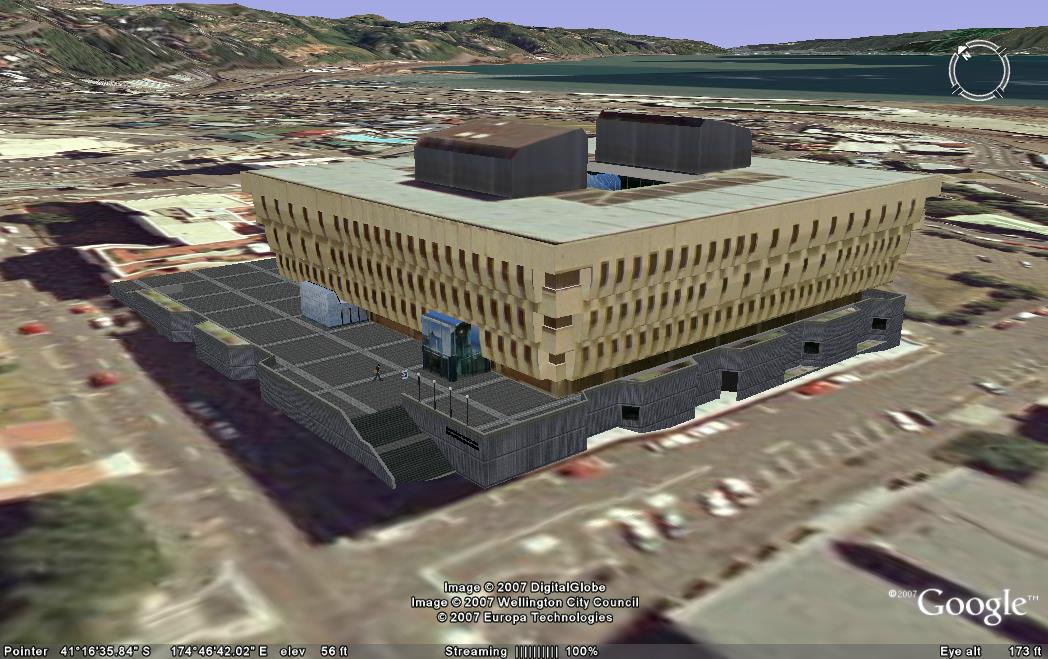
National Library 3D Building Model for Google Earth
I'm submitting this model to Google Earth today.
Google Sketchup Model

Link to this image: http://farm2.static.flickr.com/1176/962260016_9c348e09e3_o.jpg
Google Earth view

(Click on Image to Enlarge)
Link to this image: http://farm2.static.flickr.com/1010/971357387_6f747e9bc0.jpg
Link to large image: http://farm2.static.flickr.com/1010/971357387_fb76db9f49_o.jpg
Background
Google Earth is a very popular downloadable program for users, that allows one to 'dive in' and navigate the earth as seen from the air. Originally, this would have started out at as a GIS (Geographical Information System) that was mapping satellite photos on to the globe, but a rapid pace of innovation has introduced a lot of extra possibilites. Basically, if you can place it on a map, then it should be placed on this application. A very popular such feature layer is 3D buildings where if you navigate to any place on Google Earth, you can actually see 3D realistic models of buildings standing in their positions. The first such models were built by Google, but since has been opened up to accept user built contributions. Google released a very user-friendly application called Google Sketchup to build such models, and an online repository called 3D Warehouse to store the contributions. Google then assesses these for their suitability for inclusion.
Video of the Model
Current status (and how to see it in Google Earth)
Right now this model has been submitted to Google's 3D warehouse. You can search for it by going to the 3D Warehouse site and searching for "National Library" or more specifically "National Library of New Zealand". If you are using Google Earth, please note that the model will not turn up by default in Google's 3D building layer until it goes through Google's approval process, but you can still see it by following the instructions here to get the Google 3D warehouse network link.
I've been doing this project in my 'spare time' at home. Now that I've finished, my wife will finally be happy to get more of my time. Not easy being married to a techie sometimes.
Also ..
just in time for the Library building's 20th Anniversary of completion (5 August 2007)!

Relevant Links
Google Sketchup Model
Link to this image: http://farm2.static.flickr.com/1176/962260016_9c348e09e3_o.jpg
Google Earth view
(Click on Image to Enlarge)
Link to this image: http://farm2.static.flickr.com/1010/971357387_6f747e9bc0.jpg
Link to large image: http://farm2.static.flickr.com/1010/971357387_fb76db9f49_o.jpg
Background
Google Earth is a very popular downloadable program for users, that allows one to 'dive in' and navigate the earth as seen from the air. Originally, this would have started out at as a GIS (Geographical Information System) that was mapping satellite photos on to the globe, but a rapid pace of innovation has introduced a lot of extra possibilites. Basically, if you can place it on a map, then it should be placed on this application. A very popular such feature layer is 3D buildings where if you navigate to any place on Google Earth, you can actually see 3D realistic models of buildings standing in their positions. The first such models were built by Google, but since has been opened up to accept user built contributions. Google released a very user-friendly application called Google Sketchup to build such models, and an online repository called 3D Warehouse to store the contributions. Google then assesses these for their suitability for inclusion.
Video of the Model
| URL: | |
| Embed: |
Current status (and how to see it in Google Earth)
Right now this model has been submitted to Google's 3D warehouse. You can search for it by going to the 3D Warehouse site and searching for "National Library" or more specifically "National Library of New Zealand". If you are using Google Earth, please note that the model will not turn up by default in Google's 3D building layer until it goes through Google's approval process, but you can still see it by following the instructions here to get the Google 3D warehouse network link.
I've been doing this project in my 'spare time' at home. Now that I've finished, my wife will finally be happy to get more of my time. Not easy being married to a techie sometimes.
Also ..
just in time for the Library building's 20th Anniversary of completion (5 August 2007)!
Relevant Links
- Official Page on Google 3D Warehouse
- National Library of New Zealand Home Page
- Presentation at BarCamp, Scio-sphere post
- Where to get Google Earth
- How to view Google's 3D building layer
- How to view contributed 3D building content
Jul 25, 2007
More from Unshelved - the Public Library Comic Strip
There's been another interesting series from Unshelved that I covered last time, which relates to new media and old media. This time books and ephemera join the existential discussion. See below.
Monday, July 09, 2007

Tuesday, July 10, 2007

Wednesday, July 11, 2007

Thursday, July 12, 2007

Friday, July 13, 2007

Previous Related Post
Monday, July 09, 2007
Tuesday, July 10, 2007
Wednesday, July 11, 2007
Thursday, July 12, 2007
Friday, July 13, 2007
Previous Related Post
Jul 18, 2007
BarCamp
We had BarCamp at work.
BarCamp, you say? Wikipedia begins to define it as an 'unconference', but that was where the similarity ended. Normally, a BarCamp is about Information Technology professionals getting together and sharing their knowledge in an open communicative environment. When it comes to geeks (mostly unmarried) and communications it means - Laptops, Wi-Fi, Blogs, Wikis, Coding, Sleeping Bags and so on. However in our building we have more librarians then techies.
There was basically an open schedule board, where participants could sign up to give a presentation, or be a moderator. In this case, no topic was off-topic. The schedule was to be finalised, hardly 5 minute before the event. It was planned that each session, the presenter had a few minutes to showcase his/her idea and then the audience joins into a discussion. Of course, depending on the topic there were variations.
I moderated a couple of very significant sessions, presented by a fellow techie colleague related to hotdesking with terminals and remote access to office applications. There was a lot of interest from the audience/participants in what's-in-it-for-us fashion. In my turn, I presented a unprepared session (in the spirit of the un-conference) on Google Earth and our interest there (picture below). I gave a demo in 3-dimensional modeling in Google Sketchup, attempting to show how easy it is. I also presented a few ready-made models from Google's 3D Warehouse such as the Taj Mahal and Eiffel Tower. I was taken aback to notice that our CEO was also in the audience - she asked some very good questions related to importing of CAD drawings into Sketchup software. Everybody was interested in the technology and wanted to know more on how to get into this and what was required to contribute.

Overall, the event generated a lot of involvement, buzz and energy - above normal levels. I enjoyed playing the roles of organising team member, moderator and presenter.There's a plan to follow up with a similar and longer event in a month or so.
BarCamp, you say? Wikipedia begins to define it as an 'unconference', but that was where the similarity ended. Normally, a BarCamp is about Information Technology professionals getting together and sharing their knowledge in an open communicative environment. When it comes to geeks (mostly unmarried) and communications it means - Laptops, Wi-Fi, Blogs, Wikis, Coding, Sleeping Bags and so on. However in our building we have more librarians then techies.
There was basically an open schedule board, where participants could sign up to give a presentation, or be a moderator. In this case, no topic was off-topic. The schedule was to be finalised, hardly 5 minute before the event. It was planned that each session, the presenter had a few minutes to showcase his/her idea and then the audience joins into a discussion. Of course, depending on the topic there were variations.
I moderated a couple of very significant sessions, presented by a fellow techie colleague related to hotdesking with terminals and remote access to office applications. There was a lot of interest from the audience/participants in what's-in-it-for-us fashion. In my turn, I presented a unprepared session (in the spirit of the un-conference) on Google Earth and our interest there (picture below). I gave a demo in 3-dimensional modeling in Google Sketchup, attempting to show how easy it is. I also presented a few ready-made models from Google's 3D Warehouse such as the Taj Mahal and Eiffel Tower. I was taken aback to notice that our CEO was also in the audience - she asked some very good questions related to importing of CAD drawings into Sketchup software. Everybody was interested in the technology and wanted to know more on how to get into this and what was required to contribute.
Overall, the event generated a lot of involvement, buzz and energy - above normal levels. I enjoyed playing the roles of organising team member, moderator and presenter.There's a plan to follow up with a similar and longer event in a month or so.
Jun 29, 2007
Unshelved - the Public Library Comic Strip
Here's a very nice place to go on the internet if you're interested in changes and challenges taking place in libraries. Unshelved claims to be 'the world's only daily comic strip set in a public library'. It's makers are writer Gene Ambaum (yes, that's a pseudonym) and co-writer and the artist Bill Barnes. Much more information available at Primer page.
I particularly like the last few cartoons based on the theme of Internet v Library:
Monday, June 25, 2007

Tuesday, June 26, 2007

Wednesday, June 27, 2007

Thursday, June 28, 2007

Friday, June 29, 2007

Saturday, June 30, 2007

Looks like they are going to continue with these for some time, so if interested keep following this series.
I particularly like the last few cartoons based on the theme of Internet v Library:
Monday, June 25, 2007
Tuesday, June 26, 2007
Wednesday, June 27, 2007
Thursday, June 28, 2007
Friday, June 29, 2007
Saturday, June 30, 2007
Looks like they are going to continue with these for some time, so if interested keep following this series.
Jun 27, 2007
Everything is Miscellaneous - from David Weinberger
Humans have the capacity to handle the huge amounts of information, but as we get immersed in the digital information age, even that capacity is under strain. One of the main ways we organise our perception of concepts and objects around us is to categorise them, then set up hierarchies of those categories.
However, here is an interesting counter-point from David Weinberger. He's written a book - Everything Is Miscellaneous: The Power of the New Digital Disorder, which I may read 'eventually', but if you're pressed for time and rather see the video it is provided below.
Further Links
However, here is an interesting counter-point from David Weinberger. He's written a book - Everything Is Miscellaneous: The Power of the New Digital Disorder, which I may read 'eventually', but if you're pressed for time and rather see the video it is provided below.
Further Links
Feb 8, 2007
Librarians in the New World
Why use the library at all, with everything available for free on the internet and easily searchable? Wrong. Despite the formidable illusion, everything is not available on the internet. Consider the latest published journals and books, they are still under copyright and not available. Consider all the great works that haven't been converted to online media or e-books yet. Check whether the information you are getting from the net is reliable. Libraries enjoy the advantage of having authoritative information that you can quote on, and it's available for a very low membership cost, if not free. Yet all is not well in library world, librarians are wondering if they have a role in the future of information and knowledge services. An excellent article available here gives 33 reasons why librarians are still important. So, next time you visit a library, don't feel shy to consult a librarian about anything you need. Don't compare them to shop assistants trying to sell you something, they are just experts at finding the information you need.
Subscribe to:
Posts (Atom)