Showing posts with label events. Show all posts

Feb 25, 2011

So when do India/China catch up?

I've had the opportunity to see Hans Rosling before in conferences, and one can't help but be infected by his sense of enthusiasm at the stories which his powerful interpretation of statistics reveal.

I guess his broadmindedness is partly explained by this stint in India as a student. I didn't know that before.

There is a new field or term emerging called data visualisation. The experts describe 'a sea of data' which is now available globally and accessible anywhere online. The problem is how to interpret it to reveal its hidden narrative. To find the simple story within the data/information overload. Rosling has been doing that since a long time before.

Thanks to the following presentation, 37 years from is now a milestone all of Asia would have its eye on. Striding along the stage with an "environmentally-friendly" presentation pointer, Rosling looks a bit like a modern day Gandhi, just carrying a bigger stick. He understands and sympathises with the emotional touch points of Indian audience and navigates them well. The prediction graphs and statistics are not going to progress on their own, we will have to live each day to that future date and contribute to the trajectory.

In case you don't want to see the whole video, Rosling answers the question at about 14 minutes from the start...


*        *        *

Jun 9, 2010

FIFA 2010 Stadiums in Google Earth

Google have done an impressive job of 3D modelling the venues for the Football World Cup 2010 in their Google Earth application. Along with the stadiums, one can also get a good idea of the geography of the surrounding cities and scenery. The following video exhibits this:


May 25, 2010

Timelessness and Books

Walking through the local book fair, last weekend, I couldn't shake off the eerie feeling that in a few decades time this might be considered an antique market. EBooks (electronic books) are catching on in a lot of environments and are proving to be remarkably accessible and convenient. Already my eBook collection surpasses the physical one without affecting the number of boxes I store in the garage.

I also felt the quantity of people visiting the fair to be less than in previous years, perhaps that's why the organisers raised the prices of the items. I can't really imagine inflation to be a factor when dealing with old books.

My usual brief is to head straight for the Computers/Technical books section and pick up relevant copies of editions that are not obsoletely old, then head over to the science fiction area and see if anything catches my eye. After that it's a general stroll through the other sections.

In the fiction section I used to pick up a lot of Tom Clancy and Robert Ludlam's quick read books, but finally time has caught up with them. The stories are based in, and dealing with, the Cold War - the plot tries to reach the reader by making him worry about the US-Russian nuclear standoff and the great spy games being played across the geopolitical chessboard. I used to really enjoy these tales, but the end of the Cold War was has cooled my enthusiasm. There were boxes and boxes of such paperback novels, lying untouched, unbrowsed. Time has passed these tales by and they, along with their authors, may be forgotten. Some, like the Robert Ludlam's Jason Bourne series have been adapted into movies with story-lines mutated into a more modern context, having little reference to the Cold War or the original story.

A generation ago, the same thing had happened to World War II tales, with comics like 'Commando', and during/post-war Nazi conspiracy fiction.

The quick rate of environmental change is reducing the shelf-life of cultural expressions even further. Is there anything that would make a book truly timeless?

Shown below is my part of the haul this time. We took a half-empty box of only select books to the pricing counter, where they pointed out that a whole box is equal to a half box in price. We promptly went back for another round and managed to stuff a large box with extra books that were previously secondary considerations. This time, the heavy box shook the pricing counter.

book covers

Feb 5, 2010

Ancient Language becomes Extinct

Hurtling along at great speed into a globally technology-connected future, conditions are set for localised cultures, that depended on their isolation, to evolve out of existence. Now BBC passes on the message from Professor Anvita Abbi of Jawaharlal Nehru University, that Bo, one of humanity's oldest languages has vanished into history, with the demise of it's last speaker. This language used to exist in the Andaman and Nicobar Islands of India which, as the map below (from andamanese.net) shows, has undergone drastic demographic change.


I remember a documentary my family saw in the 1980s on these islands. The documentary-maker-explorers described the tribals as easily provoked and very dangerous. Standing on the ships off the shore they would wave food parcels and gifts to the nervous bewildered tribals, who kept their poison-tipped arrows poised. Not very different from the meeting of cultures portrayal in the latest Avatar movie.

Times will change and cultures will transform, but in an age where audio and video recording of every expression is possible, the heritage can be preserved to some extent. Prof. Abbi has done a lot of work in this direction recording the exact phonetics as well.
Boa Sr, who died last week aged around 85, was the last speaker of ‘Bo’, one of the ten Great Andamanese languages. The Bo are thought to have lived in the Andaman Islands for as much as 65,000 years, making them the descendants of one of the oldest human cultures on Earth.

Boa Sr was the oldest of the Great Andamanese, who now number just 52. Originally ten distinct tribes, the Great Andamanese were 5,000 strong when the British colonized the Andaman Islands in 1858. Most were killed or died of diseases brought by the colonizers.

And, sadly this will not be last language to disappear in the region.
It is generally believed that all Andamanese languages might be the last representative of those languages whose history goes back to pre-Neolithic times in Southeast Asia and possibly the first settlement of the region by modern humans. These isolated Andamanese languages that are spoken by the descendents of the aboriginal population of Southeast Asia are, at present, ‘very critical’ stage.

A useful description of how to identify languages on the path of fading out is in a paper by Prof. Abbi and colleagues:
Moribund languages are characterized by lack of will to learn and teach the heritage language. The language does not get transferred from the older to the younger generation. Another important feature of the moribund languages is loss of registers and reduced domains of use. In the restricted domains that the language is used show traces of earlier varieties in lexical items and grammatical structures once spoken. The loss of various registers also results in the lack of total mutual intelligibility even among the speakers who have retained the language.
- Where Have all the Speakers Gone? A Sociolinguistic Study of the Great Andamanese, by Anvita Abbi, Bidisha Som and Alok Das, Jawaharlal Nehru University, New Delhi. PDF file

Jan 6, 2010

Tallest building on Earth

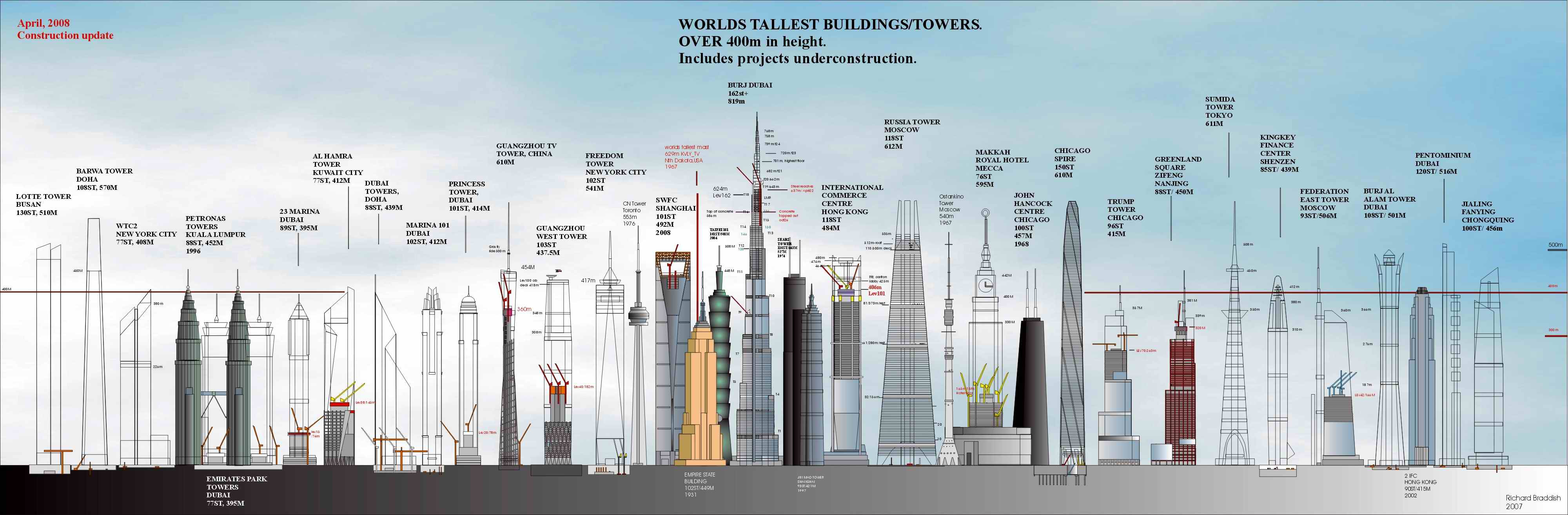
The latest tallest building on Earth, Burj Khalifa (formerly Burj Dubai), was inaugurated in Dubai in a glittering ceremony of fireworks, lights, and musical fountains. The building touches the milestone of 828 meters (or 2,717 feet) with 162 floors. Construction started on 21 September 2004, and has been completed on 4 January 2010. The opening ceremony can be seen here


A comparison with some of the existing tallest man-made structures (not counting projects in planning or construction) produces the diagram below. If you want to consider New Zealand's tallest structure, the Auckland Sky Tower at 328 meters, you can put it at approximately the size of the Eiffel Tower on the diagram. India's highest buliding is currently the Imperial towers in Mumbai at 60 floors and 249 meters.


Having the good fortune to have seen almost all the structures in the diagram(except for the Taipei 101 & CN tower), I look forward to seeing this one.

Here's another detailed diagram comparing world edifices reaching above 400 meters benchmark. The current completed buildings are in full representation, while the in-progress constructions are shown as line drawings.


It's probably unlikely that the Burj Khalifa will remain the highest building with so many newly emerging nations and conglomerates also eyeing that coveted title. Burj's predecessor the Taipei 101 (509 meters) only held the title for 6 years, not allowing the Shanghai World Financial Centre (492 meters) to even get a chance. Previous to that the Petronas Towers, Kuala Lumpur (452 meters) were the highest for 6 years, and the Willis Towers, Chicago (formerly Sears Towers) was the highest for 24 years.

However, it will be difficult to match the longevity of the building that held the title for 3880 years - the Great Pyramid of Khufu (Cheops). Here is an interesting, though very detailed diagram of the tallest buildings of the 'old' world.


Image credits: Wikipedia.org & flickr.com

Apr 1, 2009

Rockstars of Cricket


Another day to remember. An august gathering hosted by the High Commissioner of India for the visiting Indian cricket team in New Zealand. A pleasant dusk evening enhanced the outdoor setting.

The Indian cricket team has been visiting New Zealand again after a gap of over 5 years, and the changes have been significant. Led by a dynamic new captain, the team has found its confidence and has been performing phenomenally. In 2003-04 a tired Indian cricket team had been more or less steam-rolled in New Zealand. Not this time. It is the 'Black Caps' who are struggling to form a response.

The New Zealand media has been labelling this tour as a visit from 'Rockstars of Cricket', acknowledging the enormous following and gravitational pull of the Indian cricket scene.

Having met the Indian team in 2003-04 and now, the change in demeanour and body language is clear. The players seemed happier, more willing to mingle with others, less tired and clearly confident. Its always amazing how young some of these guys are. TV certainly makes them look 10 years older.

Here are some photos from the gathering.

The gathering, Bowling coach Venkatesh Prasad can be seen in the centre.

With Yuvraj Singh, one of the best international all-rounders and 20-20 star.

With Sachin Tendulkar, international cricket icon.

Indian High Commissioner Mr. K.P. Ernest meeting some of the team members


Mar 16, 2009

All right, Telstra and Google

Section 92a is probably dead in the water now, after Telstra clear pulled out of any negotiations with the Telecommunications Carriers Forum.

"You have got to have sympathy for the Government. They have inherited an ambiguous mess and you can understand why they might have hoped a code would make this go away. But we have had unprecedented customer concern and we can't try to make a bad law work."The idea our customers can be disconnected on accusation and not proof does not pass the 'fair test'."

Next, Google has also considered this important enough to make a submission

In its submission, Google notes that more than half (57%) of the takedown notices it has received under the US Digital Millennium Copyright Act 1998, were sent by business targeting competitors and over one third (37%) of notices were not valid copyright claims.

As such, Google says "Section 92A puts users’ procedural and fundamental rights at risk, by threatening to terminate users’ internet access based on mere allegations and reverse the burden of proof onto a user to establish there was no infringement."

It goes on to say, "Section 92A undermines the incredible social and economic benefits of the open and universally accessible internet, by providing for a remedy of account termination or disconnection that is disproportionate to the harm of copyright infringement online."


Mar 8, 2009

92a suspended

Seems that all the outcry by the internet user and developer community reached the government and the section 92a amendment has been suspended.

Prime Minister John Key said the law change would be delayed till March 27 to give more time for the recording and internet industries to reach an agreement setting out how ISPs would apply the clause. If no agreement was reached, section 92a might be "suspended" and the act re-written.

More at http://www.stuff.co.nz/national/1755057

Let's see where this goes, there needs to be a disengagement between rights management and internet access as opposing sides.


Feb 19, 2009

Section 92a - Guilty by Accusation

As part of the DRM (Digital Rights Management) and Copyright regime's push worldwide for compliance, a law is being proposed to be passed in New Zealand. Section 92a, that amends the country's copyright law is expected to come into force on February 28.

What has drawn near-universal criticism, is the provision that Internet Service Providers (ISPs) are to terminate the connection of anyone labelled a 'repeat infringer' of copyright violations. So just 'repeated accusations' are required, without further proof. Certainly a deviation of normal justice. The lack of response of the government to the criticism is drawing increasing ire.

At the Webstock conference, one of the game trading cards is used to highlight this.

Webstock Trading Cards - Stupid Law


At creativenewzealand.org a protest NZ Internet blackout has been called. Hence you see my profile photo blacked out on most of social websites.

New Zealand's new Copyright Law presumes 'Guilt Upon Accusation' and will Cut Off Internet Connections without a trial. Join the black out protest against it!


Another potential side-effect is it adds another reason to the creative IT community in NZ to leave for other shores.

The legislation
News article on parliament protest.
Blog post on Geekzone


Webstock '09


This is the conference I look forward to every year. A huge amount of thought and energy by come of the most creative people in New Zealand web community goes in organizing this event. Sponsored by a plethora of companies and institutions such as Google. A typical attribute of the gathering is the rather forward looking and upbeat atmosphere which is easy to catch.

This year we have speakers include people from Apple Inc., Google, and Flickr. The forum provides a good community where they can share their insights and battle-stories and the audience understand, sympathize and learn from these.

They've finally induced me into starting a twitter micro-blogging account. I'll be putting live twitter updates when I can here, and will add further Scio-sphere blogs for some of the sessions later.

Conference website: http://www.webstock.org.nz
Flickr photos: http://www.flickr.com/photos/tags/webstock/
My Twitter: http://twitter.com/apanand

Nov 10, 2008

Political Tectonics

Political leadership changes are rippling over the world. A global pessimism fueled by "worst recession since the 1930s" is helping to create an anti-incumbency wave.

Australia replaced its 10-year old prime minister, John Howard, with a youthful version.

US elected its first "African-American" American president, creating history after a long line of "European-American" presidents. The chronically demoralized black community will take some time to absorb the shock of happiness and inspiration. US has a blank canvas to redraw its global image.

4 days after US, there were elections here in NZ. And true enough the current government with a 3-term, 9-year serving prime minister, Labour's Helen Clark lost. The new prime minister is National's John Key. National includes NZ's first Sikh member of parliament, Kanwaljit Bakshi.

If has been interesting that in these elections the contestants seemed to be arguing on the same side of popular issues. With more similarities than differences it has been called "a fight for the centre". Perhaps a by-product of the demise of socialism-communism.

The pre-election cartoon (below) of the current PM and the new PM sums up the campaigns

Links

Sep 10, 2008

India - New Zealand confluence

As the New Zealand Governor General Anand Satyanand embarks on his official visit to India, a lot of the media is focussed on concluded negotiations of the Nuclear Suppliers Group (NSG) deal. This attention hides another aspect - the growing bilateral business transactions and future potential.


Like so many others around the world, New Zealand is beginning to use India's capabilities in information technology, training and business processes support. Its beneficial that the trade is going both ways. While ambitious but understaffed projects in New Zealand can use Indian scalability, the many innovative products developed in New Zealand, such as Xero, Silverstripe and Greenstone can find customers in India.

There has been a flurry of news recently:


IT courses a passage to India
By TOM PULLAR-STRECKER - The Dominion Post | Monday, 27 August 2007
www.stuff.co.nz/4178344a28.html

India has become synonymous with international technology outsourcing. Now Delhi-based training company Koenig Solutions is encouraging Kiwis to go to India to get IT qualifications that are certified by companies such as Microsoft and Cisco.

Koenig offers "boot camp" courses with the option of one-on-one training at a price it claims is half that charged by New Zealand providers.


It pays to be tough to do business in India
The Press | Monday, 25 August 2008
www.stuff.co.nz/4667439a1864.html

That New Zealand's trade commissioner to India, Paul Vaughan, has survived three years without a single case of "Delhi belly" is either a marvel of human health or extreme good luck.

Either way, when it comes to doing business in India Vaughan says it helps to be tough.

But more than that, he says it pays to be organised.

With a population of more than a billion and an economy that is growing second only to China's for speed and intensity, India can be an overwhelming place to do business.


ANZ National jobs to go to India
Wednesday, 16 July 2008
www.stuff.co.nz/4620453a13.html

ANZ National bank has told workers doing back office jobs in Wellington and Auckland that the work done by 238 of them will be done in India in the future.

The meetings yesterday with workers at the bank's lending services centre in Auckland and customer transaction service centre in Wellington were the start of a two-week consultation period over the outsourcing of the work to India.


Jade does deal with Indian partner
Monday, 23 June 2008
www.stuff.co.nz/4593535a13.html

Privately owned Jade Software Corp is hailing a deal to sell a software product in India as the most significant it has entered into in the last five years.

The Christchurch-based company said Indian partner CMC will sell Jade's student management system (SMS) throughout India.

The company did not put any numbers on expected revenue or profit from the sales but said up to 100 centres in India will have the software by the end of the year.


India key to $20m Telecom revamp
By TOM PULLAR-STRECKER - The Dominion Post | Monday, 23 June 2008
www.stuff.co.nz/4592778a13.html

Telecom has awarded Indian company Tech Mahindra a contract worth $20 million to $30m to help reshape its retail business, providing customers with more self-service options and cutting costs.

The general manager of retail transformation, Pawel Grochowicz, says that at its peak up to 300 Tech Mahindra and Telecom staff will be engaged on the multi-year project to create the "Next Generation Telecom".

"It is going to be a mix of onshore and offshore resources. We will look to bring some Tech Mahindra staff onshore, as well as having some offshore. It is very difficult to say what the exact number of Tech Mahindra people will be."


Tourism 'failing to milk Indian cash cow'
By NICK CHURCHOUSE - The Dominion Post | Friday, 30 May 2008
www.stuff.co.nz/4565126a34.html

Cash-rich Indian travellers are being stopped from taking their dream trip to New Zealand by expensive and inaccessible airlines.

The market for Indians travelling to New Zealand has risen from 19th to 12th since 2003, and, while still small, is a cash cow that is being overlooked by tourism operators, an Indian travel buyer says.

Aug 1, 2008

7x7 Session One, Seven Foundations – Our Reality 2008, Our Future 2028.

Tuesday, 22 July 2008

Intrigued by anything that claims to be inspired by TED talks, I bought the season tickets to see these 5 sessions. The short 7 minute presentations keep the audience engaged and the talks focussed. Presentation from Professor Hans Rosling playing on a LCD screen outside, a duet song by Dolly Parton and Kenny Rodgers - "Islands in the Stream" playing in the big screen inside, I took my seat.

The session was opened by Brian Sweeny, Chairman of Sweeny Vesty, a wellington based international consultancy. He started the 7x7 series along with Jan Bieringa as an ideas forum. Expressing the belief that every New Zealander needs a global edge to their work and dreams, his firm has been involved in work across 80 cities in 40 countries, with "many of the work delivered from Wellington". He advocated that New Zealand companies need to push themselves out into the world to become great. Noting the current tough economic scenario, he pointed to Toyota's market share which has been climbing even during downturns. Their lesson - the 5 Paradox Foundations - Move slowly and take big leaps, Grow steadily and remain paranoid, Be frugal and splurge, Be simple and complex, Set impossible goals and surprass them. Another roadmap referred to was 'FREDA' - Focus, Reinvention, Execution, Distribution, and Accountability. Brian hoped that thoughts and visions generated at this gathering would feed into the nation's political direction. You can also check nzedge.com


Rod Oram, international financial journalist, the chair and moderator at these series also had his 7 minute session. With plenty of humour and wit, he would carry the seminar series well. Going on the theme of 7, he talked about the 7 synergies. First, Reality - need to have a realistic self assessment of our capabilities and goals for succeeding. Opportunity - global economy and technological empowerment enabling small companies from New Zealand to have manage international concerns, leveraging our natural resources - forestry, tourism as well as filmmaking. Creativity - our size allows us to pioneer new business models, skills and relationships. Sustainability - Auckland may have 2.2 million people in 50 years, Pakehas may become a minority, we will need culture, community and business to work hand-in-hand. Commonality - of purpose, that we acknowledge each other's aspirations, but are able to find common ground for action. Leadership - New Zealanders prefer strong leadership, but we need distributed leadership in small groups. Finally, Belief - New Zealand can be a role model, bolder, strong, more certain of world contribution, and more successful. New Zealand can be the distinct attractive alternative. Only if we believe can we achieve.


He was follwed by Dr. David Skilling, CEO of the think-tank New Zealand Institute, who presented an economic analysis of current New Zealand and projected to 2030. Among the several graphs and numbers presented the overall theme was 'absence of change'. Among the OECD countries per-capita-income, we are currently 22 and are at the current rate are to remain so in 2030. However in that time the gap with Australia will increase from 30% to 60%, which can have a major impact. A Wellington Westpac stadium full of people leave for Australia every year, indefinitely or long term basis. However either too negative or positive attitudes don't help much. To make a real difference, the aspirations need to be better defined. There is a need to engage effectively with global economy or New Zealand is going to get run over.


In response came Brian Easton, and independent scholar and columnist. His presentation theme being markedly opposite - 'does material affluence boost well-being?'. Disagreeing with the theory that more products means one is better off, he also questioned the blind faith public has in economists. He gave examples of lack of correlation between well-being and material consumption - rich countries per capita income not relating to their happiness, in U.S. better to be married that have 100,000 dollars extra income. His summary - "don't worry about the economists, be happy".


Michael Field, columnist, author, expert in Pacific affairs, discussed that on his travel to Mumbai he encountered Indian civil servants who dismissed New Zealand due to its low population. Point was that New Zealand sees its much smaller Pacific neighbours in a similar vein. He proposed that perhaps there should be a union that takes away the 'small failing micro-states'. Information Technology and relaxed borders would help sustainability. Michael mentioned Tokelau and despite New Zealand attempts to have them go their own way, they prefer to be part of New Zealand. The arrival of "broadband internet, Bebo, and Sky TV" had "muted their drive of decolonization". He suggested that New Zealand should lead the way in establishing and facilitating a better Pacific union.


Professor Jacqueline Rowarth of Massey University came to talk about science research & development in New Zealand. For its size New Zealand has a good amount of research going on. Globally the demand for food is set to grow, but New Zealand does not have more land to farm. Thus farming techniques will need to become more sophisticated. However less graduates are electing to go into Agricultural Sciences and are moving to fields such as creative arts, which Jacqueline coined "the Peter Jackson effect". 26% of tertiary educated go overseas, many don't see a future in New Zealand. The science system in New Zealand needs reform, to be led more by creative 'investigator-led' research rather than 'output-driven research'. A 'Fast Forward' fund of $700 million has been created, under minister Jim Anderton and colleagues, for Science, Farms & Food. This is being matched by industry. It should help put New Zealand back in high-level research. Concluding, "If we liberate the thinkers, then we will have the recruitment that we need, and we'll have better science."


Dr. Morgan Williams, Parliamentary Commissioner for the Environment started by talking about astronauts' epiphany. The inexpressible experience of externally observing and realizing the world as an isolated and closed system. He described humanity putting enormous pressure on the resources of the globe including oceans, soil, water. There are eco-system services which we depend on and take for granted, such as bees for pollinating. One solution mentioned was bio-mimcry - taking learning from nature and applying them in the creation of our systems. Such as vineyards in North Canterbury planting flowers around to lift the pollination rates. The education system has to catch up with learning for sustainability.


Savouring an enormous amount of information in a short time span is exhilarating, but takes time to digest. The rest of the seminar series looks promises increase the tempo.

Jan 14, 2008

Bill Gates's last day

Day is nearly here where the world's richest man retires. Always known as an over-competitive vicious nerd, its good to know he has a sense of humour as well - see the following video.


Some like John C. Dvorak don't believe a word of it and say that the retirement is a joke and Bill will be back.

Dec 16, 2007

I'm a Dad!

9th December 2007, 9:29 pm. A day and date I will never forget.

My life changed forever the moment my son Antariksh was born. I've heard it said that we all fall in love with our children, and it's absolutely true. I still cannot believe how beautiful he is. One moment at a time T there are n people in the room, then at the time T+1 there are suddenly n+1 people, all of whom look absolutely happy. Simple mathematics, absolutely miraculous.

Ever since that moment, life has changed forever. All petty lazinesses, procrastinations, and selfish worries become subdued. The first concern is now my boy. The way one thinks is altered forever.

A new light enters the home and radiates happiness everywhere.

Nov 7, 2007

Movember

The things we do for charity. Actually, it's for fun as well. I got tempted into joining a group at work into participating in "Movember". What the heck is it? It is basically growing a Mo-ustache during the month of November and having people sponsor you. The rules are:

Once registered each Mo Bro start 1 November with a clean shaven face.
Then, for the entire month of Movember each Mo Bro must grow and groom a moustache according to these rules:
01 - You don’t talk about Movember outside of the month.
02 - Movember runs for 30 days. No more.
03 - There is to be no joining of the Mo to side burns—That’s a beard.
04 - There is to be no joining of the handlebars—That’s a goatie.
05 - A small complimentary growth under the bottom lip is allowed (aka a tickler).
06 - You must remain clean shaven apart from your Mo for the entire 30 days.

But wait, there's more..
Failure to conform to any of those rules may, at the absolute discretion of the Movember Committee result in instant blacklisting from further participation in Movember and entry to the Gala Parté. The Movember Committee accepts no responsibility for lost jobs, lost girlfriends/boyfriends, rashes to you or your partner or any other such
mishaps caused by a Movember Mo.
I used to sport a goatee during some of my college months, so it shouldn't be unknown territory. My wife also kindly granted her permission (she did seem very amused).

As you can probably tell, it's very 'serious'. I haven't shaved my upper lip region for 7 days now. I'll be keeping the progress (including photos) report at my Mo-Log. Now, calling all, of kind and generous inclination - feel free to sponsor my 'Mo', by clicking on the badge below. All proceeds go to the Prostrate Cancer Foundation of New Zealand. Thanks

More Mo Links


Movember - Sponsor Me