I went to the cinema to expecting to see a different Sherlock Holmes, a character repackaged to cater to a new market, in a crude manner that detracts from his original essence. Didn't happen.
The new Sherlock Holmes, played by Robert Downey Jr., is a much more dynamic character - younger, more adventurous, bit less of the English gentleman than previously depicted. Nevertheless, the core of the character hasn't been lost - the eccentricity, self-assuredness, intense concentration, and even human weaknesses. Jude Law would not have been my choice for Dr. Watson, but he's pulled it off quite well, next to Downey's Holmes. So, if you are a fan of the classic A.C.Doyle's Sherlock Holmes, you probably won't be disappointed.
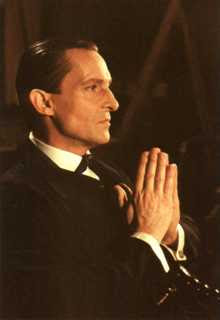 The marked difference was in the the look of Holmes. The new movie has not shied away from redefining the portrait - gone is the combed back hairstyle, the sharp jawline and chin. Downey doesn't look anything like the classic Holmes, who has been played best by actor Jeremy Brett (see on the right) in the almost complete series by Granada Television. Jeremy Brett was probably the first to capture the full theatrical intensity of the character, watching him was like following the original sketch in the books. In fact, my friend Prasanna aptly remarked that the villain in the movie is a closer look to the classic Holmes. Not commonly known is the story that the look of Holmes didn't come from the author A.C. Doyle but from his first illustrator.
The story of Sherlock Holmes first began in 1887, with the story A Study in Scarlet, published in Strand magazine, London. The Sign of Four was published in 1890, and the series The Adventure of Sherlock Holmes began in 1891 ...
With the stories serialized in The Strand came the first illustrations, and it was Sydney Paget who was to fix the the features of the tall, thin, bony character for generations of enthralled readers. The story is that Sydney was actually commissioned by mistake, instead of his brother Walter, whose work the magazine knew through his illustrations for Rider Haggard and Robert Louis Stevenson. If so, this quirk of fate was balanced by a kind of poetic justice on Sydney's part, for he used his brother's lean features as his model for Holmes. And later after Sydney's death in January 1908, Walter himself illustrated one of the stories, The Adventure of the Dying Detective. What Holmes would have looked like had Walter got there first we can only guess, for, like all the other artists commissioned to continue Sydney Paget's work, Walter did not stray far from the image of himself Sydney had fleshed upon the bones of Conan Doyle's creation.
- Preface, The Complete Illustrated Sherlock Holmes


Holmes has been seen that way ever since. There have been many actors in to play the detective, all bearing resemblance to Sydney Paget's illustration.
However, more than that, the reason Sherlock Holmes has avid followers around the world and across generations is his personality. In a sense he is very much a 20th century man, before his times, even bit of a rebel. His firm foundation in scientific principles led him to be accessible, yet his public performance of a mind-reader and magician is highly entertaining. He's a magician who, in the end, reveals his tricks of the trade, leading all who read the accounts to think that they can follow the indicated lead. He's a fictional character that has inspired creation of countless other similar fictional characters. It becomes more than just a story.
The new movie with all the benefits of modern technology (and big budget) fills in the larger picture as well. The musical score suits the setting. There are panoramic views of the London of the late 19th century, with references to the social, technological and industrial upheavels taking place ..
Arthur Conan Doyle's birth year, 1859, fell 22 years into Queen Victoria's 64-year reign, a time of unparalleled growth and optimism for the British Empire. Resources and labor taken from colonies worldwide had made England prosper, and the time of serious independence struggles lay in the distant future. Business flourished, technology blossomed, and London grew at a great rate - from one million people to six in the space of a century - creating problems of urban overcrowding familiar to us today: poverty, homelessness, drug abuse, crime. While the great divide between rich and poor and the economic and human strain of maintaining the colonies exacerbated social problems that were as yet insoluble, Victorian Britons, led by Victoria's husband Albert, put their faith in technology and science. The contrasts and conundrums of this fascinating time provided Conan Doyle with the raw material and the backdrop for Sherlock Holmes: a man of science, undistracted by the gentler passions, who moved easily through the disquieting urban space, using his wits to solve its moral and practical dilemmas.
- Sherlock Holmes, Victorian Gentleman http://sherlockholmes.stanford.edu/history.html
Come to think of it, there are actually many parallels to the enormous changes taking place in cities of the today's emerging nations. Many of similar patterns and contrasts can be spotted in places such as New Delhi. It could be a new setting for a modern fictional detective.